Page 1 of 1
Strengthening Europe’s Trade and Industrial Resilience: A Call for an EU Batteries Act
The publication argues that Europe’s economic and industrial resilience is increasingly threatened by overreliance on external suppliers, particularly in strategic sectors critical to the green and digital transitions.
- Type: Innovation Policy Lab, Publication,
- Year: 2026
- Language: English,
- Member: Friedrich Naumann Foundation for Freedom Europe (FNF Europe),
Reforming the European Semester: System Long-Term Investment in Pharmaceuticals and Healthcare
The publication explores the growing mismatch between the EU’s economic governance framework and the long-term investment needs of the pharmaceutical and healthcare sectors.
- Type: Innovation Policy Lab, Publication,
- Year: 2026
- Language: English,
- Member: Friedrich Naumann Foundation for Freedom Europe (FNF Europe),
Beyond Bureaucracy, Towards a Better Life – A Liberal Cohesion Policy for Europe’s Future
The European Union’s cohesion policy is arguably one of the most effective development policies in history For decades, it has served as a redistributive mechanism, building roads, digital networks, and public services across less-developed regions. But in an era of geopolitical tension, climate urgency, and technological disruption, a growing number of liberals argue that this approach is no longer enough.
- Type: ELF Papers, Innovation Policy Lab, Publication,
- Year: 2025
- Language: English,
- Member: Friedrich Naumann Foundation for Freedom Europe (FNF Europe),
Market-Based Environmental Leadership
As climate challenges intensify, environmental sustainability and economic competitiveness need to be pursued as mutually reinforcing goals.
- Type: ELF Papers, Innovation Policy Lab, Publication,
- Year: 2025
- Language: English,
- Member: Friedrich Naumann Foundations – Europe,
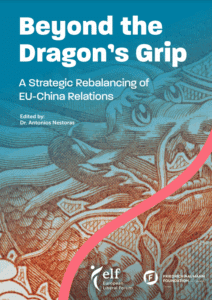
Beyond the Dragon’s Grip
Europe’s long-term prosperity and security rely on acting autonomously. While China is a vital partner for trade, technology, and investment, overdependence on a single source can undermine the EU’s resilience.
- Type: ELF Papers, Innovation Policy Lab, Publication,
- Year: 2025
- Language: English,
- Member: Friedrich Naumann Foundations – Europe,
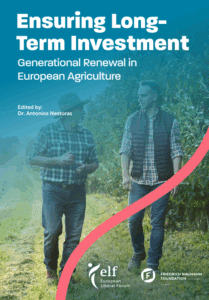
Ensuring Long Term Investment
The long-term sustainability of European agriculture depends not only on policy support through the Common Agricultural Policy (CAP) but also on private and public investment, generational renewal, and innovative business models. While CAP has been a lifeline for farmers, there remains a critical gap in long-term investment, particularly for new entrants and young farmers facing high upfront costs, low profit margins, and financial instability.
- Type: ELF Papers, Innovation Policy Lab, Publication,
- Year: 2025
- Language: English,
- Member: ELF Secretariat, Friedrich Naumann Foundation for Freedom Europe (FNF Europe),
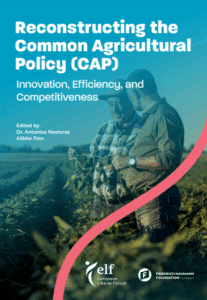
Reconstructing the Common Agricultural Policy (CAP)
Agriculture is an intersection of many political issues. On one hand, it is a deeply cultural issue connected to old traditions, the landscapes of old tales and the food of our grandmothers. On another, it is the ecosystem of economic activity that fuel rural areas, provide nutrition to growing populations and ensure trade worth millions of euros every year. Finally, the practice and policy of agriculture make us question the rights we have in relation to nature, as guardians or equals, in producing or preserving.
- Type: ELF Papers, Innovation Policy Lab, Publication,
- Year: 2025
- Language: English,
- Member: ELF Secretariat, Friedrich Naumann Foundation for Freedom Europe (FNF Europe),
Page 1 of 1