Civil society is the backbone of democracy: citizens organizing to defend freedoms, strengthen their communities, and hold power accountable. Yet […]
Civil society is the backbone of democracy: citizens organizing to defend freedoms, strengthen their communities, and hold power accountable. Yet across Europe and beyond, this space is increasingly under pressure. What begins as calls for “transparency” can quickly turn into efforts to discredit and defund independent organizations. At a time of geopolitical instability and democratic backsliding, supporting civil society is not optional, it is structural to the future of European democracy.
In this episode, Raquel García-Hermida van der Walle, Member of the European Parliament for D66, reflects on the growing challenges facing civic space, the political will needed for EU reform, and why defending civil society must be proactive, strategic, and long-term.
This podcast is produced by the European Liberal Forum in collaboration with Movimento Liberal Social and Fundacja Liberté!, with the financial support of the European Parliament. Neither the European Parliament nor the European Liberal Forum are responsible for the content or for any use that be made of.
Show note
This podcast, as well as previous episodes, is available on SoundCloud, Apple Podcast, Stitcher and Spotify.
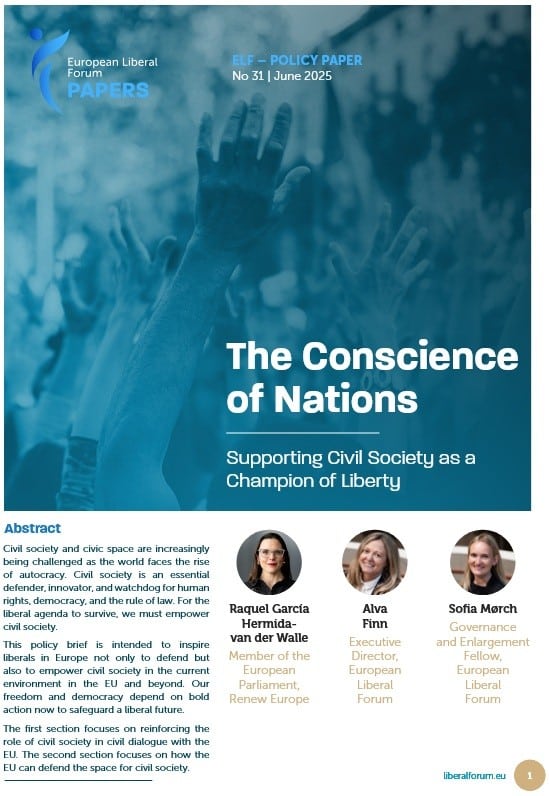
And you can find the Policy paper (31) Report here.
This podcast is produced by the European Liberal Forum in collaboration with Movimento Liberal Social and Fundacja Liberté!, with the financial support of the European Parliament. Neither the European Parliament nor the European Liberal Forum are responsible for the content or for any use that be made of.
Welcome to the Liberal Europe Podcast, it’s my great pleasure to bring you MEP Raquel Garcia-
Hermida van der Waal. The first thing that you and I are going to do is talk a little bit about the concept of civil society. For a lot of people, this is something that is a little bit abstract, but you have that experience. You, with many years doing this work, this is actually everyday people and organizations trying to make their communities better. So how can we make this work more visible so that the Europeans feel inspired and get involved?
Well, maybe to begin with, going back to what you just said, introducing the question, what is civil society? Sounds so formal and so abstract, but it’s nothing more or nothing less than, as you said, citizens who want to make their community, their country, their world a better place. And for the listeners, almost a quarter of all European citizens above the age of 15 are engaged in some sort of volunteering activity in their life. That’s a lot of people. And it goes from being a volunteer in the local church, to engaging in protests for the climate as part of a bigger organization, to helping out as many Dutch people, my neighbors do and myself, in being engaged at your local sports club to coach children. That’s also civil society. And I think it’s very important to make that very clear to other colleagues here in the European parliaments, because when we dismantle civil society, when we don’t support civil society, then we are literally taking away opportunities for our citizens to be engaged in their immediate community, but also in our society at large.
That is a fantastic answer because that takes me into a question that I don’t have on my lineup, but it’s something that bothers me a lot, which is a lot of complacency. We see more and more people getting detached. It’s an atomized society.
People just live their niche lives. They don’t interact with the outside and social media replaces a lot of that. How do you see that as not only someone that has been doing this work for a but now as someone that is contributing to the future of the European Union?
I think it’s also a framing issue. It’s how we frame this. Is it true? Is it true that people are disengaged? I don’t know. I don’t think so. think that we have to remain critical. Yeah, it could be a perception. It could be a perception, because when I look around in my village in the north of the Netherlands, when I travel to Spain to visit family and friends, when I am at the pub and I am engaging in a conversation with people, what I feel is a lot of engagement, different opinions, but a lot of engagement. People consume information. People understand that there are some things that are not going great in the world right now. People have serious concerns about things like the cost of living or are we keeping our villages livable? Do we still have schools in over 10 years? Do we have public transportation? Can our children get a job? Can they get a house? And you can see engagement as, again, very formalistic matter. But you can also see it , OK, are people in their daily lives concerned about the world around them besides the four walls of their own home? And I do see that. And I think that’s why it’s so important to have those voices also represented in the European Parliament. And that’s why it’s so important to have NGOs, civil society organizations represented here and being heard here. And on the other hand, not all of it is bad, because one thing that Internet also helped was to create those communities and to create those group of people that exactly, as you said, are interested in making things better. Can I give an example maybe about that? Remember the big earthquakes in Turkey from a couple of years ago in parts of Syria as well. The response from people in the Netherlands was amazing. I mean, there were people collecting all sorts of clothes, hygiene products and food in cans. And they were doing all this in a totally uncoordinated way from any form of government. They were doing because of the will and the desire to help others in need at the moment.
So, Raquel, the other thing that I know that you have a direct connection is the European Economic and Social Committee, meant to bring the views of civil society into EU decision making, but could be more well known. How do you think that this committee can use its advisory role to connect more directly than with people and organizations across the EU?
Well, what I’m going to say might not make me very popular in the first place, but please hear me out. I am a very, very strong believer in the role of both the Economic and Social Committee and the Committee of the Regions as advisory organs to the European Parliament, the European Commission and the Council. So I absolutely believe that they have a very important place in how we make decisions in the European Union. Now is a question if this institution should be putting a lot of energy in connecting directly with citizens. And there I’m a bit more critical because what they do is bring a lot of organizations which are already directly connected with citizens, namely civil society, in a room to bring up all those inputs, discuss and come to an advice to the parliament or the member states or the commission. And I think that those two roles are very complementary. The role of the individual organizations participating in the Economic and Social Committee. Connecting with citizens on the ground and then the institution as a whole, taking care of the more formal role of giving advices. If I think if the EEC, the European Economic and Social Committee, would have to invest enormous amounts of resources and energy and time in being recognized as one of the advisory organs in the European Union by citizens, like in spontaneous recognition, so to speak, I think that we would be spending those resources maybe not wisely. I think that we can better ensure that the organizations that give their inputs to the Economic and Social Committee, as well as the Committee of the Regions, that they are very well positioned in this house, in the European Parliament, to have a real impact in policymaking. And I think that’s the best, most effective and most efficient way of leveraging the enormous amounts of expertise and insight within the European Social and Economic Committee to ensure that the voice of citizens is heard.
Very good. Let’s continue with having the voices of Europeans being heard. I was very privileged to be on
the Renew Europe roundtables for the Conference on the Future of Europe in Strasbourg. It was a fantastic experience. And then, of course, we had the final result. And in that document, it is clearly expressed that there should be channels of communication between this very important two parts of society, which is the European Union, the European Parliament and then the citizens. Still, time flies and we’re still pretty much on the same place as we were right then. Question for you. Is it the constant crisis? Is just the share of work that the European Parliament, European Commission have or simply a lack of a clear opportunity to make this this thing more visible? What do you think?
Well, I think it’s a matter of lack of political will. And I will put this a bit in historic perspective. So, first of all, we mobilized, again, going back to resources, we mobilized as the European institutions an enormous amount of resources to bring citizens to the table, to ask them their opinion. They came up with a wonderful roadmap for reform, which we strongly need, if only to protect our competitiveness within Europe, aside from other more like ideological matters, such as do we want a federal Europe or not? But for purely practical reasons, we need the reform of the European Union. We absolutely need that. Citizens come with wonderful ideas. The European Parliament takes their reports almost in full on board with a very large majority within the European Parliament. And then it’s up to the member states to do something with that report and to the commission to push that. And nothing happens. For me, from the perspective of democratic participation, it’s a disgrace. The whole process was perfect, and then it came to the member states and it stopped completely.
So there is that fundamental problem. And then you have the issue of, OK, so how do we how can we fix that gotten to this point? And that’s where I come to lack of political will. I just don’t think that the member states at this moment are realizing maybe what the impact of not doing anything or the impact of doing nothing is going to be. Because like I said, if we want to remain competitive, if we want to face Putin, if we want to to be able to act strongly against autocrats and want to be autocrats like Viktor Orban, we will need to reform our institutions. And citizens realize that very well, because that’s something that in every pretty much every advice from the European Social and Economic Committee and from civil society organizations. One of the points that everyone agrees on is you need to reform the institutions.
You need to ensure that there are more channels for direct participation from citizens. You need to ensure that citizens can elect the president of the European Commission. You need to ensure that European citizens form a real political community because they can vote on representatives from different countries, which we call transnational lists.
You need to ensure that veto is absolutely limited to the bare minimum, if not eliminated completely. Those are insights that also come from my conversations with civil society organizations and the member states are doing nothing with them. Which is a waste opportunity because most of the countries have a high percentage of approval in society. Portugal is one of them. Poland is another one. Two examples that come to my mind.
So how can then our listeners push for that? Should we be talking with our governments or is it has to be more centralized and from central to the member states? I think that talking to governments is definitely the way to go, because at the end of the day, it is the governments who have a seat at the table at the council and they’re the ones deciding with one another if they’re going to launch a treaty revision procedure or not, as this parliament has repeatedly
asked for. So I would say to the listeners, please engage in every way you can with your national governments and make them see the light.
Raquel, another necessary conversation with you has to do with NGO transparency. We’re sitting in the seat of European Union democracy. The European Parliament has a function that can push to a fair and straightforward transparency system that protects the credibility of NGOs. Where are we on that and what do you think more needs to be done? What we have seen in recent years since the beginning of this mandate, in any case, is that this new right wing
majority in this parliament has started what I can I cannot define as anything else than a witch
hunt on NGOs and started with the, as they call them, the green NGOs, because, you know, the
green NGOs would be following the diktats from the European Commission.
They would be lobbying in a way which should not be accepted. They would be spending
money in an irresponsible way. They would be doing all sorts of things, according to the people
who started this witch hunt, which have repeatedly been fact checked and nothing, nothing of
what they say seems to be right.
If you look at the agreements and the grants that the European Commission is giving to these
NGOs, so it started like it started like an accountability and transparency issue. But I would like
to tell the bigger picture here and I would like to sketch the bigger picture. There is a worldwide
movement to curtail.
And to, yeah, to curtail civil society and to drain those voices, demonize and defund, and those
two are very connected. First you demonize and that ends up with defunding because civil
society is uncomfortable because they come here and they tell us the truth because they
uncover corruption, because they mobilize waste, because they mobilize citizens for better laws
against climate change. And there are a lot of lawmakers, a lot of colleagues of mine in this
house who find that uncomfortable.
And the best way to eliminate something which is uncomfortable is by defunding it. And that’s
what we’re seeing right now. And I can say that I am very proud that my delegation, but also
within Renew, we have been a very strong defender of the role of civil society organizations and
civil society at large, and that we are trying everything we can to protect and to defend, as I
wrote also with Alfa in that position paper, not only defend in a reactive sort of way, but also
protect in a proactive sort of way.
So when we are discussing how to allocate funds in the new multiannual financial framework,
the new budget for the European Union, I want to see money going in a structural way to NGOs
who are fighting for our democracy, who are fighting for our values, who are fighting for access
to information, who are fighting for our climate, who are fighting for religious freedoms, for
example, something which is very dear to a lot of us here in Europe. We need civil society to
fight that fight. And we see that in member states of our union, Hungary is one of the
examples, Slovakia another.
But then you see it also worldwide. And I’m thinking as we record this, what’s happening in the
United States, for example, in Georgia, in Moldova. So apart from that call that you just did right
now, which is at the European Union, at the European Parliament level, and actually as we
record this, there was a press release regarding the European Democracy Shield.
We’re not going to go into it. I’ll have you back on the podcast. But there’s the EU strategy for
civil society as an entire section on it.
But for people like yourself and me, we see the importance of having a vibrant, strong civil
society, of having these democratic systems, as you said, with checks and balances and with
speaking truth to power. How do you see the future? I know that you’re an optimist by nature, I
understood that just a minute ago. I said that we’re all being atomized and you’re like, no, no,
Ricardo.
No, it’s not. It’s not. It’s not just a perception.
So where do you see us going then as a global society? Well, if we don’t do anything, then civil
society will die. And it won’t even be a slow agony like that of Europe described by Mario
Draghi. It will be very fast.
And what you will see is that what you destroy, no, what you have been, what has taken us
decades to build, will be destroyed within a couple of years. The post-war, all the post-war
victories. All the victories on the field of civil society, citizens’ participation, checks and balances.
It has taken so long to build up and it can be destroyed so quickly. And when it’s gone, once it’s
gone, it’s gone. And I’ve seen this, the risk of this happening in Poland.
I was there earlier this year speaking with civil society organizations. I have been to Slovakia.
I’ve spoken to civil society organizations.
I see it in my own country, in the Netherlands, where because of the budget cuts, there are
many NGOs, many civil society organizations who don’t know if they will make it past a couple
of years into the future. And we’re seeing it in the United States, where people are literally
being taken to courts on false pretense just to discredit them, which is something that we also
see in Hungary. And we see that also in other member states in the European Union.
So what I do know is if we don’t do something now, if we don’t act now, then it will be very late
or too late in too many places to rebuild everything that has been attacked at the moment. So
my hope is that within this parliament, but also in member states and also outside the
European Union, that we will be able to keep all those positive forces together and fighting the
same fight. So, for example, I’m very hopeful when we are able to connect with lawmakers in
the United States who are different levels, are fighting the good fights against the everyday
stronger autocratic tendencies of the Trump administration.
And I’m very happy when I see countries where civil society organizations are showing
enormous resilience in the face of gigantic threats and challenges, like in Hungary or in
Slovakia or in Poland. And I think that our role as policymakers in the European Parliament, and
that is why I’m very happy with the publication of the civil society strategy of the European
Commission, is to ensure that we are very attentive to dog whistles. That we understand that
when some colleagues in this house call for transparency, quote unquote, what they’re asking
is for defunding.
That we push for sufficient budgets in a structural way, again, not incidental, but structural for
civil society organizations. And that we’re able to, in plenary speeches, in committee meetings,
in our daily dealings with the media and with other colleagues, that we are able and ready to
defend them and to stand for them. And that means also that when we, the allies of civil
society, as we like to see ourselves, when we don’t get it right, we also have to accept that they
will have criticism.
And that’s for us to just take it like a grown up and try to do better the next time. Raquel, time
flies when we’re having fun. We’re getting to the end of our time together, but I want you to tell
me, please, where can people follow you online? Well, I’m to be followed on LinkedIn.
You can find me on Instagram, handle Raquel in Europa, Raquel in Europe, but then in Dutch.
And you can find me on Blue Sky. Oh, I love it.
I’m going to follow you right away. I’m going to put all the links on the podcast show notes.
Also, I’m going to put the link to the policy paper, The Consciousness of Nations, where Raquel
was very, very generous in giving us a contribution.
We are in good hands with people like you leading the way. This was a privilege and a delight to
have you here. And if there is a call for action, you just laid it out beautifully.
Raquel Garcia, Emir de Van Der Waal, MEP in the European Parliament by D66. Thank you so
much for coming to the podcast. I hope to have you back soon.
Thank you. Obrigada. Tell us a little bit about yourself.
What was the path that you took before I have you now on the podcast? My professional life
has been mostly in the NGO sector, in the civil society sector. So I’m Raquel. I grew up in Spain,
in Madrid.
And after three years stint in D.C., in the United States, I moved to the Netherlands, to a little
village in the north of the country where I have been living for the last 13 years, I guess now.
And I’m a newly elected MEP, or newly elected, this first term MEP since the elections of June
2024 for D66 within the Renew group. So apart from all the work that you’ve been doing, where
did it start? So you always been a very political conscious, civil society conscious young girl
growing up in Spain, or this is something that came later because there was something that in
your life that triggered that interest? No, politics was always very much present at home, even
though there was no one who was politically engaged or involved in any active way.
But, you know, watching the news at night together, that was something which we did every
day, reading the newspaper on Sunday, having pretty heated discussions as Spanish family
discussions can be over dinner or lunch about politics. And from a very young age, I definitely
had that interest. And I could channel that for many, many years through my work for different
NGOs internationally, for different civil society organizations.
But at some point when I was already in the Netherlands, I really felt the need to do a bit more,
to give a bit more, which led me to deciding, OK, well, I want to be involved by a political party.
And some research led me to D66, where I felt very much at home from the beginning. And
then at some point it was time for me to decide, OK, do I want to do this as a side gig or do I
want to make my work and life in politics? And that’s what I did.
So I decided to run for the European Parliament. You made the right choice. We’re very happy
to have you in the Liberal family.
One more follow up on this. So this drive that comes from working in civil society, working in
NGOs like you did, and then you became a politician now in the European Parliament, where I
imagine your days are just like legislation, legislation, regulation, legislation. So how do you are
able to then manage those two aspects of your life? For me, they’re very complementary.
That’s one of the first things that I remember saying to my team when we landed here and we
needed to to give a bit of a framework on how we were going to to fill in our days or fill up our
days because we’re very full. And one of the things that I said is for me, being a counterpart
and being someone that civil society can turn to is very important, because I know from the
other side of the table how difficult it is to get a foot on the door in the door here in the
European Parliament, especially when compared with the business sector. Nothing wrong with
lobbying from the business sector.
They’re very much welcome. But you do see a disbalance, an imbalance between the two the
two sectors. And I think that both of them are necessary for good decision making.
And that brings me to the second part, which is decision making. So all of my contacts with civil
society, with citizens, with organisations, they really inform my work as a lawmaker. So I try to
bring in a lot of the input that I get into regulation and laws and the more formal part of being
an MEP.
This is all for now. I’ll be back soon with more podcasts. You can always visit the website
liberalforum.eu to know more about the activities of the European Liberal Forum.
So until the next episode, let’s keep making the world a better place. You are listening to the
Liberal Europe podcast by the European Liberal Forum. This podcast was co-financed by the
European Parliament.