Page 1 of 7
EU Labour Market: Liberal Solutions to Retain, Attract and Innovate
Europe’s economy is changing faster than its workforce can adapt. Populations are aging, classrooms lag behind new skill demands, and borders still divide talent that should flow freely. From digitalization to the green transition, every major transformation depends on people, their ability to learn, move, and reinvent themselves. Yet Europe’s labour market remains trapped in yesterday’s structures, struggling to meet the challenges of tomorrow.
- Type: ELF Papers, Publication,
- Year: 2025
- Language: English,
- Member: ELF Secretariat, LIPA,
Borrowed Brilliance: When Rivals Use our Liberal Policies
This analysis illustrates how liberal reforms across Italy, Spain, Germany, and France have often emerged less from ideological zeal and more from urgent economic or political pressures.
- Type: ELF Papers, Publication,
- Year: 2025
- Language: English,
- Member: ELF Secretariat, Fondazione Luigi Einaudi ETS,
The EU’s Coupling Decoupling Dilemma
Nearly two decades after the EU’s last enlargement rounds in 2004 and 2007, Russia’s war in Ukraine has brought enlargement back to the top of the EU’s strategic agenda.
- Type: ELF Papers, Publication,
- Year: 2025
- Language: English,
- Member: ELF Secretariat,
Europe Reimagined: A Liberal Road to Enlargement
In June 2025, the European Liberal Forum (ELF), together with LYMEC and the Boris Divković Foundation, brought together young activists, students, and professionals in Sarajevo for the Liberal Hack Youth Event 2025. Over an intensive 24 hours, participants tackled one of Europe’s defining challenges: how to reimagine EU enlargement in a liberal, strategic, and future-oriented way.
- Type: ELF Papers, Publication,
- Year: 2025
- Language: English,
- Member: Boris Divkovic Foundation, LYMEC,
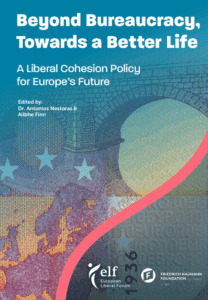
Beyond Bureaucracy, Towards a Better Life – A Liberal Cohesion Policy for Europe’s Future
The European Union’s cohesion policy is arguably one of the most effective development policies in history For decades, it has served as a redistributive mechanism, building roads, digital networks, and public services across less-developed regions. But in an era of geopolitical tension, climate urgency, and technological disruption, a growing number of liberals argue that this approach is no longer enough.
- Type: ELF Papers, Innovation Policy Lab, Publication,
- Year: 2025
- Language: English,
- Member: Friedrich Naumann Foundation for Freedom Europe (FNF Europe),
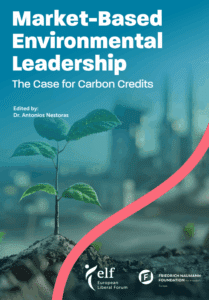
Market-Based Environmental Leadership
As climate challenges intensify, environmental sustainability and economic competitiveness need to be pursued as mutually reinforcing goals.
- Type: ELF Papers, Innovation Policy Lab, Publication,
- Year: 2025
- Language: English,
- Member: Friedrich Naumann Foundations – Europe,
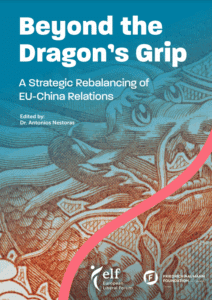
Beyond the Dragon’s Grip
Europe’s long-term prosperity and security rely on acting autonomously. While China is a vital partner for trade, technology, and investment, overdependence on a single source can undermine the EU’s resilience.
- Type: ELF Papers, Innovation Policy Lab, Publication,
- Year: 2025
- Language: English,
- Member: Friedrich Naumann Foundations – Europe,
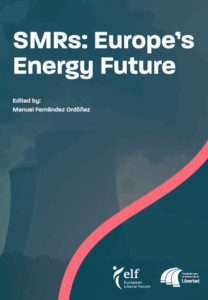
SMRs: Europe’s Energy Future
The nuclear energy field stands at an unprecedented moment in time. For the first time in history, hundreds of start-up companies—backed by private investment—are emerging with innovative designs, particularly Small Modular Reactors (SMRs).
- Type: ELF Papers, Publication,
- Year: 2025
- Language: English,
- Member: ELF Secretariat, Fundalib,
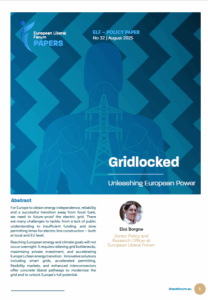
Gridlocked: Unleashing European Power
For Europe to obtain energy independence, reliability and a successful transition away from fossil fuels, we need to future-proof the electric grid. There are many challenges to tackle, from a lack of public understanding to insufficient funding, and slow permitting times for electric line construction – both at local and EU level
- Type: ELF Papers, Publication,
- Year: 2025
- Language: English,
- Member: ELF Secretariat,
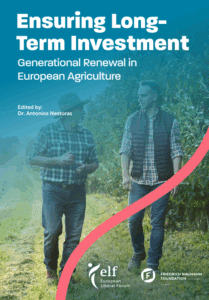
Ensuring Long Term Investment
The long-term sustainability of European agriculture depends not only on policy support through the Common Agricultural Policy (CAP) but also on private and public investment, generational renewal, and innovative business models. While CAP has been a lifeline for farmers, there remains a critical gap in long-term investment, particularly for new entrants and young farmers facing high upfront costs, low profit margins, and financial instability.
- Type: ELF Papers, Innovation Policy Lab, Publication,
- Year: 2025
- Language: English,
- Member: ELF Secretariat, Friedrich Naumann Foundation for Freedom Europe (FNF Europe),
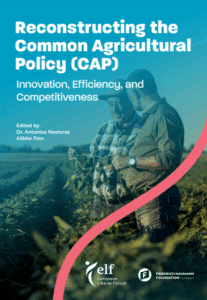
Reconstructing the Common Agricultural Policy (CAP)
Agriculture is an intersection of many political issues. On one hand, it is a deeply cultural issue connected to old traditions, the landscapes of old tales and the food of our grandmothers. On another, it is the ecosystem of economic activity that fuel rural areas, provide nutrition to growing populations and ensure trade worth millions of euros every year. Finally, the practice and policy of agriculture make us question the rights we have in relation to nature, as guardians or equals, in producing or preserving.
- Type: ELF Papers, Innovation Policy Lab, Publication,
- Year: 2025
- Language: English,
- Member: ELF Secretariat, Friedrich Naumann Foundation for Freedom Europe (FNF Europe),
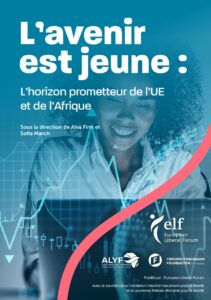
L’avenir est jeune-L’horizon prometteur de l’UE et de ‘Afrique
L’Afrique et l’UE se sont engagées dans des discussions approfondies sur la nécessité d’une collaboration équitable et ont souligné l’importance de parvenir à un partenariat équitable. Il est temps pour nous, les libéraux, d’agir et d’aller au-delà du dialogue. Les auteurs espèrent que les libéraux des deux continents pourront s’inspirer des idées contenues dans cette publication.
- Type: ELF Papers, Publication,
- Year: 2025
- Language: French,
- Member: ELF Secretariat, Friedrich Naumann Foundations,
Page 1 of 7