Page 1 of 16
![[Policy Paper 10] Enhancing the Commission’s AI Act Proposal](https://liberalforum.eu/wp-content/uploads/2022/02/Screenshot-2022-02-25-08.28.39-234x300.png)
[Policy Paper 10] Enhancing the Commission’s AI Act Proposal
The Commission’s AI Act Proposal aims at deploying safer AI systems in the Internal Market. Although many welcome aspects in the Proposal contribute to it, the Proposal as it is currently drafted does not go far enough to protect fundamental rights.
- Type: Policy Paper,
- Year: 2022
- Language: English,
Reform to support the European Green Deal
The European Green Deal is not just the next economic strategy. It becomes the most important priority that is meant to ensure EU’s recovery, resilience and strategic sovereignty all together.
- Type: Publication,
- Year: 2022
- Language: English,
- Member: LIPA,
Free Voices: LGBT + Rights in Eastern Europe
This publication is an attempt to describe the situation of LGBTIQ+ people in Eastern Europe, thirty years after the process of transformation began in the region.
- Type: Publication,
- Year: 2022
- Language: English,
- Member: Projekt:Polska,

Violence Against Women in European Politics
Thorough systemic changes for reaching true gender equality in the political representation of women in European societies, of course, require research of reasons for women’s underrepresentation when it comes to participation in politics.
- Type: Publication,
- Year: 2022
- Language: English,
- Member: International Educational Center (IEC),
[ELF Briefing] Multi-Speed Europe – Embracing the Reality
The existence of a Multi-Speed Europe is a reality. The concept relates to the pace of integration – or lack thereof – of Member States into different structures of Union. The dissimilarity of integrative speed is intrinsically linked to the different resources, goals and socio-economic backgrounds of each Member State.
- Type: Publication,
- Year: 2022
- Language: English,
[Policy Paper 9] A Europe of Values
For many years, the EU has been struggling to respond adequately to rule of law violations in its own member states. With the Next Generation EU recovery funds now in the hands of governments who seem to be moving away from the democratic and liberal values of the EU, continued inaction is affecting the people’s trust in the EU project. “A Europe of Values” learns from the examples of CVM, Article 7 proceedings and inconsistencies within the EU institutions themselves to show that it is now time to move beyond dialogue towards concrete actions.
- Type: Policy Paper,
- Year: 2022
- Language: English,
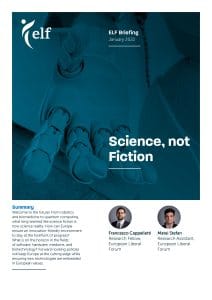
[ELF Briefing] ELF Science, Not Fiction 2021
Welcome to the future! From robotics and biomedicine to quantum computing, what long seemed like science fiction is now science reality. How can Europe ensure an innovation-friendly environment to stay at the forefront of progress? What is on the horizon in the fields of software, hardware, medicine, and biotechnology? Forward-looking policies will keep Europe at the cutting edge while ensuring new technologies are embedded in European values.
- Type: Publication,
- Year: 2022
- Language: English,
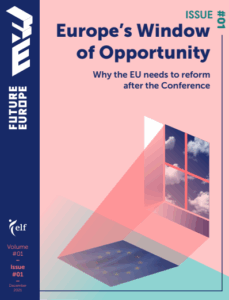
[FEU Journal 1] Europe’s Window of Opportunity
This journal fills a gap that we believe exists between academia, policymaking,
and the wider public. European Studies as an academic field has experienced
a formidable boom in recent decades. This has led to a number of crucial
insights into the development of the European project, its strengths and
weaknesses, and ways to address them. Yet these are not always considered
by policymakers and indeed are often unknown beyond specialised circles.
At the same time, academics sometimes tend to stay too long in their ivory
towers and could benefit from the practical knowledge of those involved
in the day-to-day business of making Europe and from getting a better
grip on the wishes and aspirations of its citizens. This is this dialogue that
Future Europe wants to foster.
- Type: Future Europe Journal,
- Year: 2021
- Language: English,
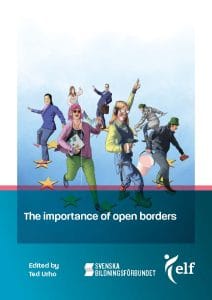
The importance of open borders
Year: 2021 Editor: Ted Urho ISBN: 978-2-39067-018-6 When Covid-19 hit in March of 2020, we abruptly learned what a closed-off world feels like. In Europe, the free movement of goods and people came to a complete standstill, as nation-states closed their borders in an attempt to control the spread of the virus. For the labour market, it was a disaster. […]
- Year: 2021
- Language: English,
- Member: Svenska Bildningsförbundet,
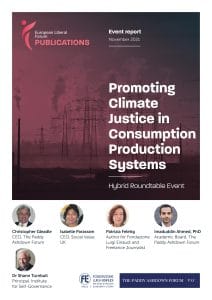
Promoting Climate Justice in Consumption Production Systems
As the twenty-first century progresses, we see increasing technological advances, further growth of the culture of sustainability, the circular economy, Environmental and Social Governance, more Climate and Biodiversity COP’s and a great many other talking shops. This suggests a rather toxic paradox. From fragmented specialisms to the fragmentation of people, planet, and profit, has created a culture that lacks the capability to develop truly durable, holistic political solutions to […]
- Type: Publication,
- Year: 2021
- Language: English,
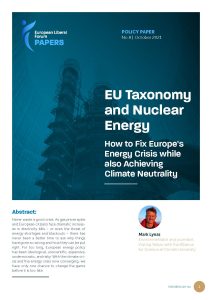
[Policy Paper 8] EU Taxonomy and Nuclear Energy: How to Fix Europe’s Energy Crisis while also Achieving Climate Neutrality
With the climate crisis and the energy crisis now converging, we have only one chance to change the game before it is too late.
- Type: ELF Papers, Policy Paper,
- Year: 2021
- Language: English,
- Member: Mark Lynas,
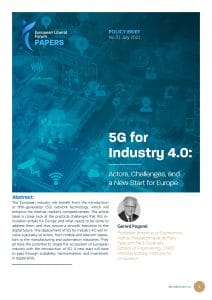
[Policy Brief 3] 5G for Industry 4.0: Actors, Challenges, and a New Start for Europe
The article takes a closer look at the practical challenges that 5G innovation entails for Europe and what needs to be done to address them and thus ensure a smooth transition to the digital future.
- Type: ELF Papers, Policy Brief,
- Year: 2021
- Language: English,
- Member: Gerard Pogorel,
Page 1 of 16