Page 1 of 7
![[Policy Paper 10] Enhancing the Commission’s AI Act Proposal](https://liberalforum.eu/wp-content/uploads/2022/02/Screenshot-2022-02-25-08.28.39-234x300.png)
[Policy Paper 10] Enhancing the Commission’s AI Act Proposal
The Commission’s AI Act Proposal aims at deploying safer AI systems in the Internal Market. Although many welcome aspects in the Proposal contribute to it, the Proposal as it is currently drafted does not go far enough to protect fundamental rights.
- Type: Policy Paper,
- Year: 2022
- Language: English,
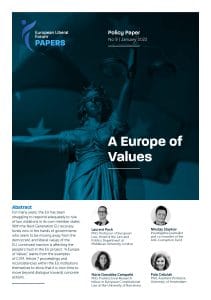
[Policy Paper 9] A Europe of Values
For many years, the EU has been struggling to respond adequately to rule of law violations in its own member states. With the Next Generation EU recovery funds now in the hands of governments who seem to be moving away from the democratic and liberal values of the EU, continued inaction is affecting the people’s trust in the EU project. “A Europe of Values” learns from the examples of CVM, Article 7 proceedings and inconsistencies within the EU institutions themselves to show that it is now time to move beyond dialogue towards concrete actions.
- Type: Policy Paper,
- Year: 2022
- Language: English,
![[Policy Brief 4] The 'Brussels Effect' Digitalisation and the Future of Transatlantic Relations by Antonios Nestoras](https://liberalforum.eu/wp-content/uploads/2022/01/Policy-Brief-4-The-Brussels-Effect-Digitalisation-and-the-Future-of-Transatlantic-Relations-212x300.jpg)
[Policy Brief 4] The ‘Brussels Effect’ Digitalisation and the Future of Transatlantic Relations
With the release of the new DSA-DMA legislative package, the EU wants to echo its ‘Brussels effect’ into the realm of digitalisation.
- Type: ELF Papers, Policy Brief,
- Year: 2022
- Member: ELF Secretariat,
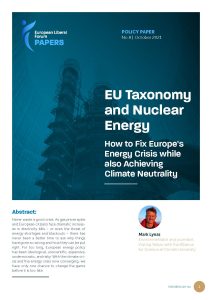
[Policy Paper 8] EU Taxonomy and Nuclear Energy: How to Fix Europe’s Energy Crisis while also Achieving Climate Neutrality
With the climate crisis and the energy crisis now converging, we have only one chance to change the game before it is too late.
- Type: ELF Papers, Policy Paper,
- Year: 2021
- Language: English,
- Member: Mark Lynas,
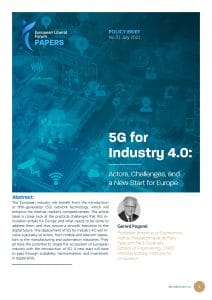
[Policy Brief 3] 5G for Industry 4.0: Actors, Challenges, and a New Start for Europe
The article takes a closer look at the practical challenges that 5G innovation entails for Europe and what needs to be done to address them and thus ensure a smooth transition to the digital future.
- Type: ELF Papers, Policy Brief,
- Year: 2021
- Language: English,
- Member: Gerard Pogorel,
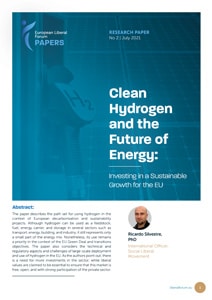
[Research Paper 2] Hydrogen and the Future of Energy: Investing in a Sustainable Growth for the EU
The paper describes the path set for using hydrogen in the context of European decarbonisation and sustainability projects.
- Type: Research Paper,
- Year: 2021
- Language: English,
- Member: ELF Secretariat,
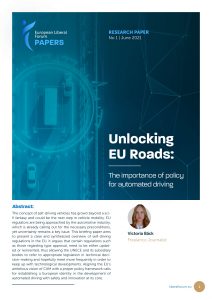
[Research Paper 1] Unlocking EU Roads: The Importance of Policy for Automated Driving
The concept of self-driving vehicles has grown beyond a sci-fi fantasy and could be the next step in vehicle mobility. This briefing paper aims to present a clear and synthesized overview of self-driving regulations in the EU.
- Type: ELF Papers, Research Paper,
- Year: 2021
- Language: English,
- Member: Victoria Bäck,
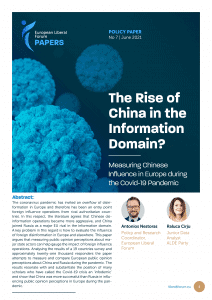
[Policy Paper 7] The Rise of China in the Information Domain?: Measuring Chinese Influence in Europe during the Covid-19 Pandemic
This paper argues that measuring public opinion perceptions about major state actors can help gauge the impact of foreign influence operations.
- Type: ELF Papers, Policy Paper,
- Year: 2021
- Language: English,
- Member: Antonios Nestoras, Raluca Cirju,
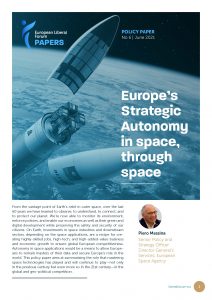
[Policy Paper 6] Europe’s Strategic Autonomy in Space, Through Space
From the vantage point of Earth’s orbit in outer space, over the last 60 years we have learned to observe, to understand, to connect, and to protect our planet.
- Type: ELF Papers, Policy Paper,
- Year: 2021
- Language: English,
- Member: Piero Messina,
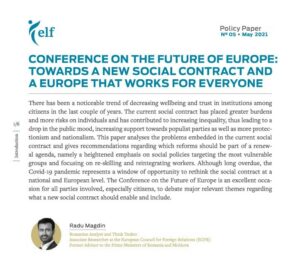
[Policy Paper 5] Conference on The Future of Europe: Towards a New Social Contract and a Europe that Works for Everyone
Year: 2021 Author: Radu Magdin ISSN: 2736-5816 DOI: 10.53121/ELFPP5 There has been a noticeable trend of decreasing well-being and trust in institutions among citizens in the last couple of years. The current social contract has placed greater burdens and more risks on individuals and has contributed to increasing inequality, thus leading to a drop in the public mood, increasing support towards […]
- Type: ELF Papers, Policy Paper,
- Year: 2021
- Language: English,
- Member: Radu Magdin,
![[Policy Paper] Towards a Social EU? Maria Alesina](https://liberalforum.eu/wp-content/uploads/2021/05/0006-212x300.jpg)
[Policy Paper 4] Towards a Social EU? A Liberal Vision for Social Policy Beyond the Porto Summit
The pandemic and subsequent economic fallout from prolonged restrictive measures are changing the socio-economic landscape across Europe, directly affecting millions of citizens.
- Type: ELF Papers, Policy Paper,
- Year: 2021
- Language: English,
- Member: Maria Alesina,

[Policy Brief 2] Europe’s Party Politics: Liberal, Illiberal, or Quasi-Liberal?
Year: 2021 Author: Takis S. Pappas ISSN: 2736-5816 DOI: 10.53121/ELFPB2 For a time, post-war European politics was dominated by the liberal type of party. These broadly liberal parties were who originally envisaged the idea of a united Europe and subsequently carried the torch for the advancement of an open society in a progressively integrated Europe under rule of law.
- Type: ELF Papers, Policy Brief,
- Year: 2021
- Language: English,
- Member: Takis Pappas,
Page 1 of 7