Page 1 of 7

[Policy Brief 2] Europe’s Party Politics: Liberal, Illiberal, or Quasi-Liberal?
Year: 2021 Author: Takis S. Pappas ISSN: 2736-5816 DOI: 10.53121/ELFPB2 For a time, post-war European politics was dominated by the liberal type of party. These broadly liberal parties were who originally envisaged the idea of a united Europe and subsequently carried the torch for the advancement of an open society in a progressively integrated Europe under rule of law.
- Type: ELF Papers, Policy Brief,
- Year: 2021
- Language: English,
- Member: Takis Pappas,
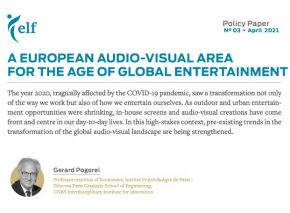
[Policy Paper 3] A European Audio-Visual Area for the Age of Global Entertainment
The year 2020, tragically affected by the COVID-19 pandemic, saw a transformation not only of the way we work but also of how we entertain ourselves.
- Type: ELF Papers, Policy Paper,
- Year: 2021
- Language: English,
- Member: Gerard Pogorel,
![[Discussion Paper] Costly Trade-offs Versus Cost of Inaction](https://liberalforum.eu/wp-content/uploads/2021/07/0011-212x300.jpg)
[Discussion Paper 5] Costly Trade-offs Versus Cost of Inaction: Divergent Views of the Risks and Benefits of EU Climate Governance
As climate governance remains high on the EU political agenda, this discussion paper examines the risks and benefits of EU climate governance from two very different standpoints.
- Type: Discussion Paper, ELF Papers,
- Year: 2021
- Language: English,
- Member: Bjorn Lomborg, Sebastian Oberthür,
![[Policy Brief] A StratCom For Liberals in a Post-Covid Europe Radu Magdin](https://liberalforum.eu/wp-content/uploads/2021/04/0010-212x300.jpg)
[Policy Brief 1] A StratCom For Liberals in a Post-Covid Europe
This policy brief will introduce a few crucial elements for a successful liberal StratCom in the post-Covid world.
- Type: ELF Papers, Policy Brief,
- Year: 2021
- Language: English,
- Member: Radu Magdin,
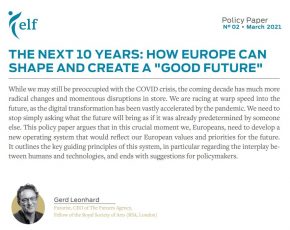
[Policy Paper 2] The Next Ten Years: How Europe Can Shape and Create a “Good Future”
This policy paper argues that in this crucial moment we, Europeans, need to develop a new operating system that would reflect our European values and priorities for the future.
- Type: ELF Papers, Policy Paper,
- Year: 2021
- Language: English,
- Member: Gerd Leonhard,
![[Policy Paper] Enabling Healthier Dietary Choices in Europe Vincent Delhomme](https://liberalforum.eu/wp-content/uploads/2021/03/0008-212x300.jpg)
[Policy Paper 1] Enabling Healthier Dietary Choices in Europe: Towards Enhanced Front-of-Pack Information on Foods and Alcoholic Beverages
This policy paper presents two reforms that would improve EU food information requirements: the generalisation of a common EU ‘front-of-pack’ evaluative label on all foodstuffs and the introduction of ingredients and nutritional information on alcoholic beverages.
- Type: ELF Papers, Policy Paper,
- Year: 2021
- Language: English,
- Member: Vincent Delhomme,
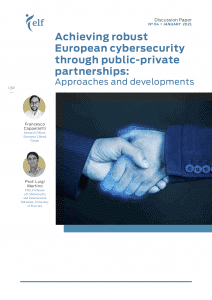
[Discussion Paper 4] Achieving robust European cybersecurity through public-private partnerships: Approaches and developments
Opportunities offered by cyberspace and telecommunications have changed how businesses, governments and people function.
- Type: Discussion Paper, ELF Papers,
- Year: 2021
- Language: English,
- Member: Francesco Cappelletti, Luigi Martino,
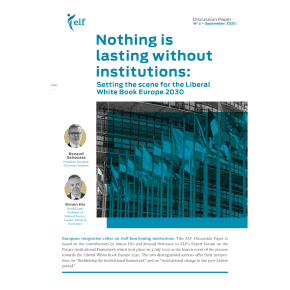
[Discussion Paper 3] Nothing is lasting without institutions: Setting the scene for the Liberal White Book: Europe 2030
S.Hix and R. Dehousse offer their view on “Rethinking the institutional framework” and on “Institutional change in the post-Lisbon period”.
- Type: Discussion Paper, ELF Papers,
- Year: 2020
- Language: English,
- Member: Renaud Dehousse, Simon Hix,
[Discussion Paper 2] Post-Pandemic Legislatures: Is real democracy possible with virtual parliaments?
Legislatures are crucial for functioning democracies. The Coronavirus has changed them. This ELF Discussion Paper by Olivier Rozenberg asks if real democracy is possible with virtual parliaments.
- Type: Discussion Paper, ELF Papers,
- Year: 2020
- Language: English,

[Discussion Paper 1] Banking Union: imminent crisis and possible solutions
The Banking Union is an essential pillar of the Economic and Monetary Union. However, it is still not completed and not as resilient and weather-proof as one would wish.
- Type: Discussion Paper, ELF Papers,
- Year: 2020
- Language: English,
- Member: Giuseppe Russo, Graham Bishop,
Page 1 of 7